
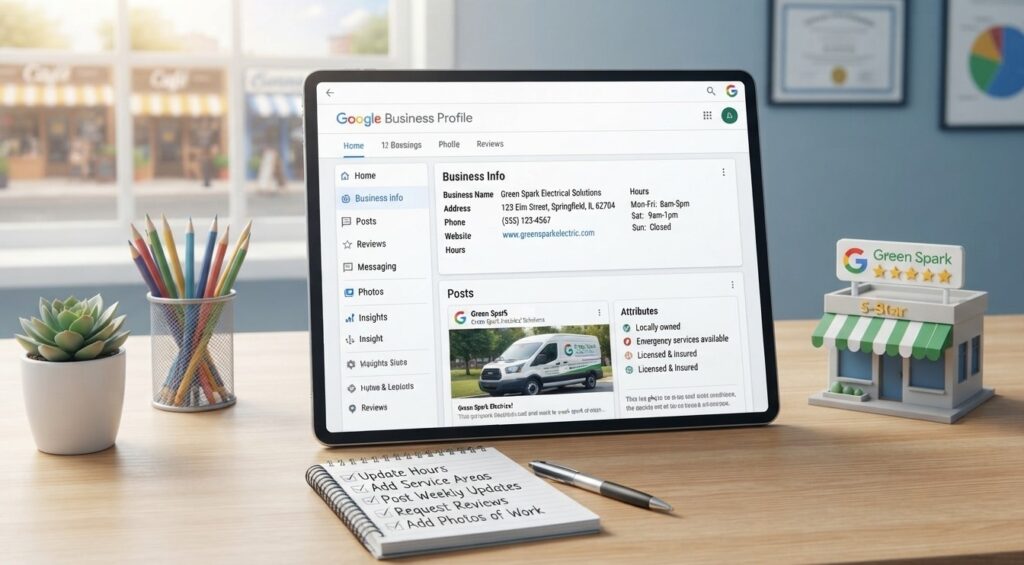
Most HVAC companies lose local jobs before the phone ever rings. A homeowner’s furnace dies at 6 AM, they search “furnace repair near me,” and three companies show up in the map pack. If yours isn’t one of them, the job goes to a competitor with a weaker crew and a better listing.
This guide covers the local SEO strategy that moves an HVAC contractor’s rankings: Google Business Profile setup, keyword targeting, citations, reviews, and the content that turns a service page into a ranking page. It skips the vague advice about “building your online presence” and sticks to the steps, the numbers behind them, and a timeline for when results show up.
Why Local SEO Matters for HVAC Contractors
Understanding the basics of local SEO for HVAC companies starts with one fact: Google treats a phone search for “HVAC repair” as local intent automatically, without the searcher ever typing “near me.” Roughly three in four people who search for a contractor on their phone contact or visit a business the same day, according to Google’s own consumer research.
That’s the moment local SEO decides whether you get the call. A homeowner with a dead AC unit in July isn’t scrolling to page two. They’re calling the first two or three companies in the map pack and booking with whoever answers with a real appointment slot.
The stakes are real dollars. Every ranking position lost in the map pack costs an HVAC company real revenue, measured in service calls and installs.
Optimize Your Google Business Profile (Step-by-Step)
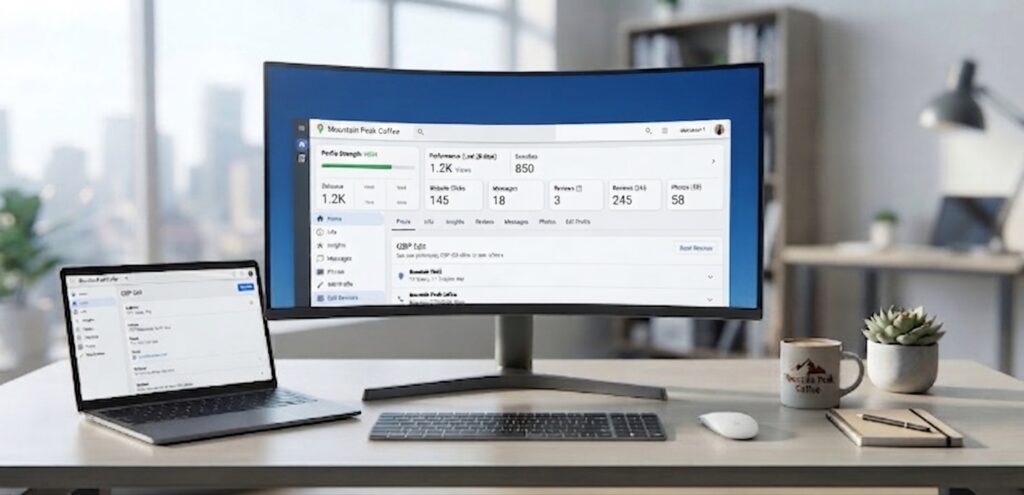
Google Business Profile (GBP) carries more ranking weight than any other local SEO factor. Local Search Ranking Factors study puts GBP signals at 32% of total Local Pack ranking weight, ahead of on-page signals (19%), reviews (16%), links (15%), behavioral signals (8%), and citations (7%). For HVAC contractors, that means a sloppy profile caps your rankings no matter how good the rest of your site is. This is the first thing we audit as part of our SEO services for HVAC businesses.
Here’s the build, in order:
- Claim and verify the listing under your real business name. Don’t stuff keywords into the name field, as in “Smith HVAC (Furnace Repair, AC Installation).” Google can suspend profiles for this, and it reads as amateur to homeowners comparing options.
- Set the primary category first. “HVAC Contractor” outranks “Air Conditioning Contractor” or “Heating Contractor” alone in most markets, because it signals full-service capability to Google’s matching system. Getting this one field wrong is one of the most common reasons a well-built profile still underperforms.
- Add every secondary category that applies: furnace repair, air duct cleaning, heat pump installation. Each one expands the searches you can appear in.
- Fill in service areas by city or ZIP instead of relying on a radius alone. If you run crews in Plano, Frisco, and McKinney, list all three by name.
- Upload real photos: trucks with your logo, technicians mid-repair, completed installs, and before-and-after duct or system shots. Complete profiles pull noticeably more clicks and calls than ones with a handful of stock images.
- Post updates weekly. Seasonal promotions, maintenance reminders before summer, financing offers ahead of a system-replacement season.
- Turn on messaging and Q&A, and answer both within a few hours. A profile that goes quiet looks abandoned to Google and to homeowners comparing three companies at once.
GBP actions such as calls, direction requests, and website visits have grown steadily as more searches happen on mobile. GBP activity feeds the ranking signal directly, so treat weekly posts as required maintenance.
Target the Right Local Keywords (with Examples)
Keyword research for HVAC contractors breaks down into three intent buckets, and mixing them up wastes budget. Emergency keywords (“AC repair now,” “furnace not working [city]”) carry the highest intent and the least patience. Someone typing these wants a phone number in the next ten seconds.
Service and location keywords (“air conditioner installation [city],” “duct cleaning near me”) match people actively comparing contractors. Informational keywords (“how often to change a furnace filter,” “AC not cooling causes”) pull in early-stage searchers who aren’t ready to book yet, but who remember your name when they are.
A few examples of how these map to real search behavior in a mid-size metro:
•“hvac repair [city]”: high intent, moderate competition
•“emergency furnace repair [city]”: very high intent, lower competition, especially valuable in winter
•“ac installation cost [city]”: comparison intent, strong conversion once someone lands on a clear pricing page
•“best hvac company [city]”: comparison intent, driven heavily by reviews and reputation
•“why is my ac leaking water”: informational, useful for blog content and voice search
One of the practical HVAC SEO tips agencies skip: build a dedicated page for every service in every city you serve, instead of one generic “services” page trying to rank for all of them at once. A single page titled “HVAC Services” competing for “furnace repair Frisco,” “AC installation Frisco,” and “duct cleaning Frisco” all at once will lose to competitors running three focused pages. On-page signals reward specificity over breadth.
Build Local Citations & NAP Consistency
NAP consistency, meaning your business Name, Address, and Phone number matching exactly across every directory, doesn’t sound like it should matter this much. It does. Google can’t confirm you’re a single, real business when your listings disagree with each other, so it hedges by ranking you lower until the picture is clear.
For an HVAC company that’s run under a slightly different name on Yelp, Angi, and Nextdoor for five years, that mismatch costs rankings without anyone tracing the cause.
Fixing this takes real hours of work. Automated tools can flag mismatches, but correcting them still means someone updating each directory by hand. Start with the highest-authority directories like Google Business Profile, Yelp, Angi, HomeAdvisor, the Better Business Bureau, and your state’s contractor licensing board where it’s publicly searchable. Work down from there to trade-specific directories, and correct the primary data aggregators too, since they feed hundreds of smaller directories automatically.
Accurate hours and contact details matter beyond citations, too. A wrong closing time costs more than a click. It costs a homeowner who drove to an address that looked open online and found it locked, and most people won’t give a business a second chance after that.
Generate & Manage Customer Reviews
Reviews are the second-heaviest local ranking factor after Google Business Profile signals. They also do something rankings alone can’t: they close the sale once someone finds you. Nearly half of consumers won’t consider a business with fewer than 20 reviews at all.
For HVAC contractors, that math is unforgiving. A company with 8 reviews and a 4.9 average is invisible to the 47% who filter by volume before they filter by rating. A company with 60 reviews and a 4.3 average beats them both on trust and on ranking signal.
Build a system, not a habit you remember when business is slow:
•Text or email a review request within an hour of finishing the job, while the fix is still fresh and the technician’s name is still in the homeowner’s head.
•Use a direct link to your Google review form. Every extra click a homeowner has to make cuts completion rates.
•Respond to every review within 24 to 72 hours, positive or negative. A profile that never responds looks unmanaged, and homeowners notice.
•Never offer a discount or incentive in exchange for a review. It violates Google’s policies and most review platforms’, and it puts your listing at risk of suspension.
•Answer negative reviews calmly and specifically. A generic, templated reply turns off other people reading it, but a real response, one that names the job and the fix, rebuilds trust for everyone else reading the thread.
Recency matters as much as volume. A company with 200 reviews from three years ago and none since looks stalled next to a competitor adding a handful of new reviews every month.
Create Location-Specific Content
Location-specific content is where an HVAC SEO strategy usually breaks down because most contractors either skip it or fake it. A page titled “AC Repair in Round Rock” using the exact same 300 words as “AC Repair in Georgetown” with the city name swapped doesn’t fool Google, and it doesn’t help the homeowner reading it either.
Real location content answers questions specific to that service area: how a Houston summer with 90% humidity strains a system differently than a Phoenix summer at 110 degrees and 15% humidity, how older neighborhoods with 1970s ductwork need different service than new-build subdivisions on single-stage units, what permit rules apply in that specific city or county, and what installation costs typically run given local labor rates and equipment shipping.
Beyond city-specific service pages, ongoing blog content builds the on-page and topical signals Google rewards. Content that answers the questions your own techs get asked on every call works well: why a system short-cycles, what a SEER rating changes on a utility bill, when a repair stops making financial sense against a replacement.
Seasonal maintenance guides, published ahead of the season rather than during it, add another layer. This content won’t rank for the highest-competition emergency keywords, but it builds the topical depth that supports every other page on the site, and it captures research-phase searches that turn into calls two or three weeks later.
Add schema markup, specifically LocalBusiness and Service schema, to every location page. It won’t move rankings on its own, but it helps Google and LLMs parse exactly what service you offer in exactly which city, supporting the relevance signal Google uses to match your business to a specific search.
How Long Until You See Results? (Timeline)
Local SEO for HVAC contractors moves faster than national SEO, but it still isn’t instant. Here’s a realistic breakdown based on how these projects typically play out.
Weeks 1 through 4
This is foundational work. You claim and verify the GBP listing, build it out fully, complete a full site audit, and start citation cleanup. Some contractors see early map pack movement in this window if the GBP was previously unclaimed or badly neglected, since that’s the fastest fix available.
Months 2 through 3
You finish citation corrections, turn review requests into a routine, and start publishing location pages. Early ranking movement shows up on lower-competition, longer-tail keywords, like “furnace repair” in a smaller suburb rather than the metro’s core city.
Months 3 through 6
This is where most HVAC contractors start seeing real lead volume. Map pack rankings for competitive service-plus-city terms typically land in this window, with organic rankings for the same terms following close behind.
Months 6 through 12
Rankings stabilize and compound. Reviews, citations, and content all reinforce each other by this point, and a contractor who stayed with the process for the full year typically reaches ROI-positive territory here.
Contractors who quit at month 2, right before the movement starts, are the ones who conclude local SEO doesn’t work. It does. It just doesn’t run on a two-week schedule.
Real Example: How We Helped an HVAC Company Improve Local Rankings
A Phoenix based HVAC contractor came to us ranking outside the map pack for their core terms and averaging 26 leads a month from organic and local search combined. The starting problems were common ones: an unclaimed GBP listing, 14 inconsistent citations across major directories, and 92 total reviews sitting at a 4.7-star average.
Over 2 months, the work followed the order laid out above. We claimed and fully built out the GBP listing with accurate categories and service areas, then corrected all 14 citations across primary directories and data aggregators. Next came a review request system launched at the point of service completion, which moved the review count from 92 to 113 at a 4.9-star average. We closed out the work by publishing 6 city-specific service pages covering the 3 cities in the contractor’s service area.
By the end of 3rd month, the business ranked in the top 3 of the map pack for “AC Repair Phoenix” and saw a 38% increase in calls attributed to Google Business Profile actions. Organic traffic to the location pages grew by 47%.
You can see more examples of this kind of turnaround in our client results.
Common Mistakes to Avoid
A handful of mistakes show up across almost every HVAC contractor’s local SEO audit we run.
•Multiple GBP listings for the same location, usually left over from an old listing that never got merged after a move or rebrand. This splits reviews and ranking signal across two profiles instead of consolidating them into one.
•Keyword-stuffed business names in GBP, such as “Austin HVAC Repair & AC Installation Experts.” Google has suspended profiles for this, and it reads as amateur to homeowners comparing options.
•A single “Service Areas” page trying to rank for every city and every service at once, instead of dedicated pages for each combination.
•No review request process, relying on customers to leave reviews unprompted. Most happy customers won’t leave a review without being asked, even when they’re satisfied with the work.
•Ignoring negative reviews instead of responding. A calm, specific reply often brings the customer back and shows everyone else reading the thread how the business handles problems.
•Treating local SEO as a one-time project instead of ongoing maintenance. Citations drift as directories merge, phone numbers change, and business hours shift with the seasons. A cleanup from two years ago doesn’t hold.
Fixing these mistakes is the fastest way to turn a stalled HVAC SEO strategy into one that produces calls, and most of them take hours of correction work rather than a rebuilt website.
FAQs
How much does local SEO cost for an HVAC company?
Pricing depends on market competition and how much cleanup the starting profile needs, but most agencies price local SEO for home service businesses between $500 and $2,500 a month, with competitive metro markets running higher.
Businesses looking for affordable SEO for HVAC companies should be cautious of anything priced far below that range. A $150-a-month package usually can’t cover the hours that citation cleanup and content creation require, and it tends to lean on shortcuts that put the GBP listing at risk.
Is local SEO better than paid ads for HVAC contractors?
They solve different problems. Paid ads produce leads immediately but stop the moment the budget stops. Local SEO takes longer to build but keeps producing leads without added spend once rankings hold. 75% of small businesses report that local SEO generates more leads than paid advertising though most run both channels together rather than choosing one.
Do I need a website if my Google Business Profile already ranks well?
Yes. GBP alone can’t hold rankings without a supporting website, and organic results (the listings below the map pack) run on a different set of signals that a GBP listing can’t fill by itself. A contractor with only a GBP presence is also fully dependent on Google’s platform, with no owned channel to fall back on if the listing gets suspended or flagged.
How many reviews does an HVAC company need to rank well?
There’s no fixed number, but the data points to 20 as a meaningful threshold: 47% of consumers won’t consider a business with fewer than 20 reviews. Past that point, consistency matters more than total count. A steady stream of 3 to 5 new reviews a month outperforms a stagnant total of 150.
How fast can I rank for “HVAC repair near me”?
For a well-optimized GBP in a low-to-moderate competition market, early map pack movement can appear in 2 to 4 weeks. Competitive metro markets usually take 3 to 6 months for that same term. Organic rankings for the equivalent phrase on your website typically take longer, in the 4-to-8-month range.
Get Your Free Local SEO Audit
We pull your current GBP score, citation consistency, and review benchmarks and compare them against your top 3 local competitors. No cost. No obligation. At JK SEO Studio, we build this exact playbook for every HVAC client we work with.