

A breaker panel starts sparking at 9 PM, and the homeowner is already searching “emergency electrician near me” before they’ve finished checking the fuse box. Three electrical contractors show up in the map pack. If yours isn’t one of them, that job, and the panel upgrade that usually follows it, goes to someone else. That’s the entire case for seo for electrical contractors in one search.
This guide covers what actually moves rankings for an electrical contractor: Google Business Profile setup, the keywords worth targeting, citations, reviews, and the service pages that turn traffic into booked jobs. It skips the generic advice and sticks to the steps, in order.
Why Local SEO Matters for Electricians
Electrical work splits into two very different searches, and most contractors optimize for only one of them. There’s the panic search: a dead circuit, a tripped panel, a burning smell, where the homeowner calls the first licensed electrician who answers.
Then there’s the planned search: a panel upgrade before a home sale, an EV charger install, a rewiring quote for an older house, where the homeowner compares three or four companies over a few days before booking.
Ranking for both requires different content and different urgency, but both run through the same local ranking system. An electrician who only shows up for “electrician near me” misses the higher-ticket, higher-margin jobs that come from planned-work searches, which is where a real local SEO marketing strategy pays off the most.
The map pack is also where trust gets decided before a phone call happens. A homeowner comparing electricians for a panel upgrade is looking at star ratings and review counts in the search results before they open a single website. The core mechanics behind this, GBP, citations, reviews, content, are the same fundamentals covered in our local SEO tips for HVAC contractors guide, just applied to a different trade.
Optimize Your Google Business Profile
Google Business Profile carries the heaviest weight of any local ranking factor, and for electrical contractors specifically, a thin or neglected profile is the single biggest reason a well-run company still loses jobs to a smaller competitor with a better listing. It’s also why we run GBP Optimization & Management as its own dedicated service rather than a small add-on task.
- Claim and verify under your real, licensed business name. Don’t stack services into the name field, as in “Jones Electric (Panel Upgrades, Rewiring, EV Chargers).” Google treats this as a policy violation and can suspend the listing.
- Set the primary category correctly. “Electrician” as the primary category outperforms narrower categories like “Electrical Installation Service” alone in most markets, because it signals full-service capability across residential and light commercial work.
- Add every relevant secondary category: panel upgrade service, EV charger installer, electrical inspector, lighting contractor. Each category expands the searches your profile can surface in.
- List service areas by city and ZIP rather than a radius setting alone, especially if you cover a metro with several distinct suburbs.
- Upload real photos of trucks, licensed technicians on the job, panel and wiring work in progress, and finished installs. Stock photography does more harm than good on a licensed trade listing.
- Post weekly. Seasonal reminders about surge protection before storm season, EV charger promotions, panel upgrade financing offers.
- Turn on messaging and Q&A and respond within hours, not days. A profile that goes quiet reads as inactive to both Google and homeowners comparing options.
Target High-Intent Local Keywords (Emergency, Panel Upgrade, Rewiring)
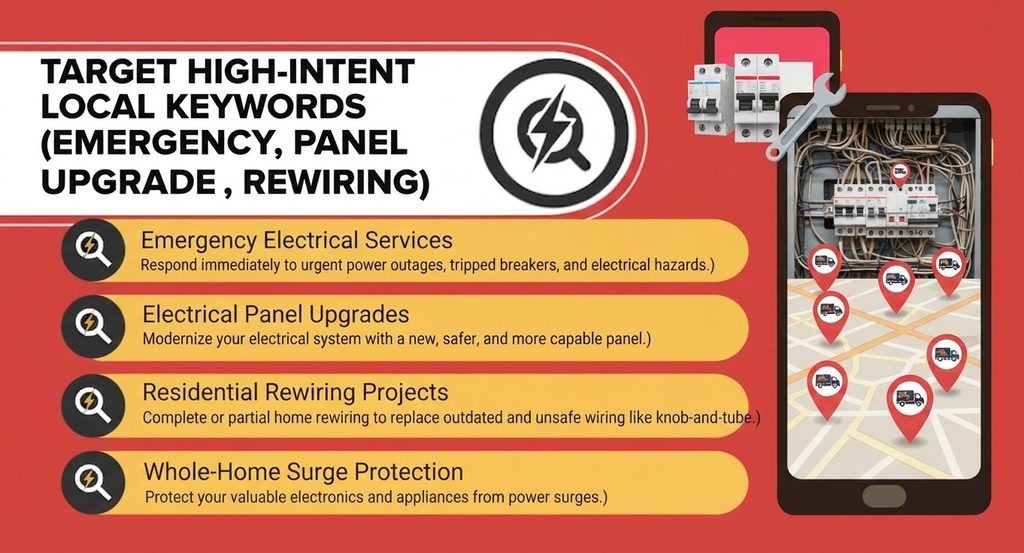
Electrical keyword intent breaks into three buckets, and treating them the same wastes both content and ad budget.
Emergency keywords (“electrician near me,” “power outage electrician [city],” “circuit breaker not working”) carry the highest urgency and the lowest patience. These searchers want a phone number answered now, not a contact form.
Planned-project keywords (“panel upgrade cost [city],” “EV charger installation [city],” “house rewiring [city]”) come from homeowners actively comparing quotes. These convert well on pages with clear pricing ranges and process explanations.
Informational keywords (“how much does a panel upgrade cost,” “signs you need to rewire your house,” “is a flickering light dangerous”) pull in early-stage searchers who aren’t ready to book but remember your name later.
A few examples of how these map to real search behavior:
•“emergency electrician [city]”: very high intent, low competition, especially valuable overnight and on weekends
•“panel upgrade cost [city]”: comparison intent, strong conversion with a clear pricing page
•“ev charger installation [city]”: growing search volume year over year, lower competition than panel or rewiring terms in most markets
•“house rewiring [city]”: high-ticket comparison intent, driven heavily by trust signals like licensing and reviews
•“why does my breaker keep tripping”: informational, useful for blog content and voice search
Build a dedicated page for each core service in each city served, rather than one general “electrical services” page trying to rank for everything at once. A single page competing for “panel upgrade Denver,” “EV charger installation Denver,” and “rewiring Denver” simultaneously loses to competitors running three focused pages.
Build Local Citations & Reviews
NAP consistency, your business Name, Address, and Phone number matching exactly across every directory, matters more for licensed trades than most other local businesses, because licensing boards and trade directories add extra citation sources that need to match too.
Start with the highest-authority directories: Google Business Profile, Yelp, Angi, HomeAdvisor, the Better Business Bureau, and your state electrical licensing board where the listing is public. Then work down to trade-specific directories and the data aggregators that feed hundreds of smaller sites automatically.
Reviews carry nearly as much ranking weight as citations, and they do the trust-building work that a listing alone can’t, a pattern confirmed across trades by Local Search Ranking Factors study. For electrical work specifically, where safety and licensing are the biggest homeowner concerns, review content that mentions licensing, code compliance, or clean panel work carries outsized influence on a homeowner’s decision.
Build a system:
•Text or email a review request within an hour of job completion, while the technician’s name and the fix are still fresh.
•Use a direct link to your Google review form to cut friction.
•Respond to every review, positive or negative, within 24 to 72 hours.
•Never offer a discount for a review. It violates platform policy and risks the listing.
Answer negative reviews specifically and calmly. A real response naming the job and the resolution rebuilds trust for everyone else reading the thread.
Create Service-Specific Content Pages
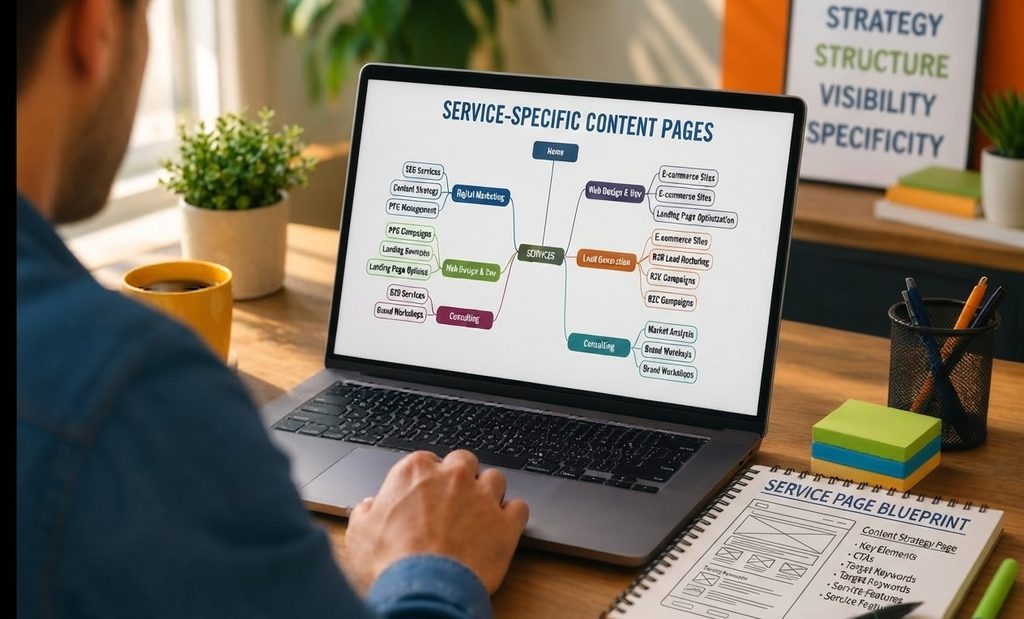
Generic “residential and commercial electrical services” pages rank poorly because they try to compete for every keyword at once and win none of them. Service-specific pages, one for panel upgrades, one for EV charger installs, one for rewiring, one for lighting, each targeting a specific city, perform better because they match exactly what the searcher typed.
Real service content answers the questions a homeowner actually has: what a 100-amp to 200-amp panel upgrade typically costs in that specific market, what permit and inspection process applies in that city or county, how older knob-and-tube or aluminum wiring changes a rewiring quote, and what rebates or incentives exist locally for EV charger installation.
Beyond service pages, blog content built around the questions technicians hear on every call, why a breaker keeps tripping, what GFCI outlets protect against, when a flickering light signals a real problem versus a loose bulb, builds the topical depth that supports every other page on the site.
Add LocalBusiness and Service schema markup to every service page. It won’t move rankings by itself, but it helps Google and LLMs match your business to the right service in the right city, which supports the relevance signal behind local rankings. This page-by-page structure is exactly what we build into our local SEO services for every client we work with, electrical, HVAC, or plumbing.
Real Example / Case Study
An electrical contractor in Charlotte, NC came to us ranking outside the map pack for core terms and averaging 22 leads a month across organic and local search combined. The starting issues were familiar: an incomplete GBP profile missing half its service categories, 11 inconsistent citations, and 74 reviews sitting at a 4.6-star average.
Over 3 months, we rebuilt the GBP profile with a full category set and accurate service areas, corrected all 11 citations across primary directories and data aggregators, and launched a review request system triggered at job completion, which moved the review count from 74 to 98 at a 4.8-star average. We closed the work by publishing 8 service-specific pages covering panel upgrades, rewiring, and EV charger installation across the contractor’s 4-city service area.
By the end of month 4, the business ranked in the top 3 of the map pack for “panel upgrade Charlotte” and “electrician near me,” and saw a 34% increase in calls attributed to Google Business Profile actions. Organic traffic to the new service pages grew by 41%. You can see more results like this on our client results page.
FAQs
How is electrical contractor SEO different from general local SEO?
The core mechanics, GBP, citations, reviews, content, are the same. The difference is keyword structure. Electrical searches split more sharply between true emergencies and high-ticket planned projects like panel upgrades and rewiring, so content and page structure need to serve both intents separately rather than treating every search the same way.
How long does it take to rank for “electrician near me”?
In a low-to-moderate competition market with a well-optimized GBP, early map pack movement can show up in 2 to 4 weeks. Competitive metro markets typically take 3 to 6 months. Organic website rankings for the same term usually take longer, in the 4-to-8-month range.
Is local SEO worth it for a small electrical contractor with one truck?
Yes, often more so than for larger companies. A single-truck contractor competing against multi-crew companies can’t out-advertise them on paid spend, but a tightly optimized GBP and a handful of strong service pages can still win map pack visibility in a specific service area.
How many reviews does an electrical contractor need to rank well?
There’s no fixed number, but the data points to 20 as a meaningful threshold, since a large share of consumers filter out businesses with fewer reviews than that before they even look at the rating. Past that point, a steady stream of new reviews each month matters more than total volume.
Do panel upgrade and rewiring pages need separate content from general service pages?
Yes. These are high-ticket, high-consideration jobs, and homeowners researching them want pricing ranges, permit information, and process details specific to that service, not a paragraph buried inside a general “electrical services” page.
Get Your Free Local SEO Audit
We’ll analyse your current Google Business Profile, citation consistency, review performance, and local visibility and compare them against your top 3 local competitors. No cost. No obligation. You’ll get a clear snapshot of where you’re currently standing, what’s holding back your local rankings, and the opportunities that could help you generate more qualified leads from Google.
At JK SEO Studio, we turn these insights into a tailored Local SEO strategy designed specifically for electrical contractors.
See where you stand and what it would take to outrank your local competition.