
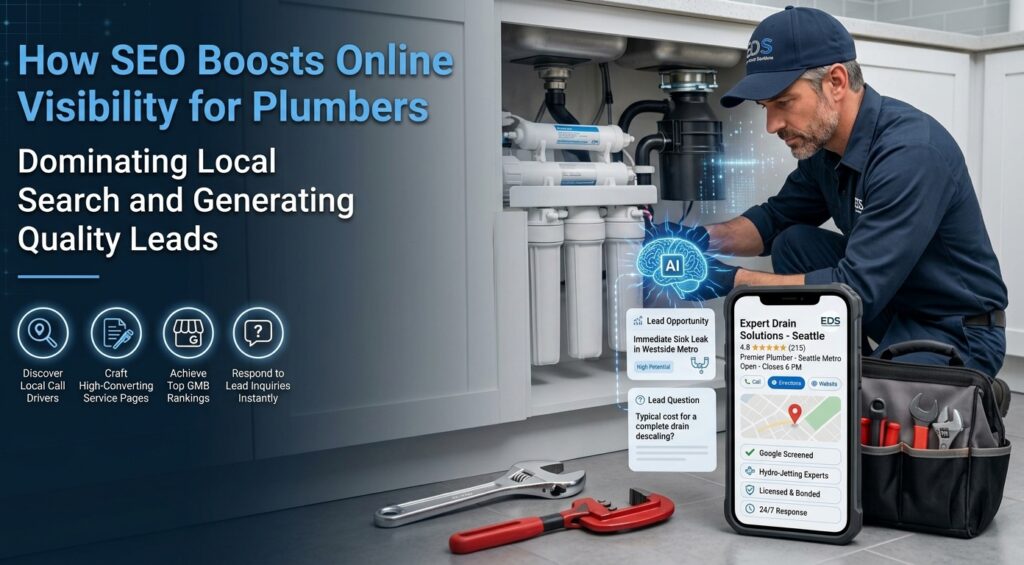
A burst pipe doesn’t wait for business hours. Someone standing in two inches of water grabs their phone, searches “emergency plumber near me,” and calls whichever company looks like it can be trusted to show up and fix the problem. That single moment is what SEO for plumbing services is built around: getting found first, and looking like the right choice the second someone lands on your page.
Visibility gets you into that search. Trust is what gets the phone call. The two aren’t separate goals. Done well, SEO builds both at the same time, because most of the work that makes Google show your business also makes a homeowner believe in it.
Why visibility comes first for plumbers
Plumbing searches skew local and urgent. Someone with a leaking water heater isn’t researching plumbing companies for next month, they’re comparing the three or four options Google shows them right now, usually the map pack results at the top of the page. If your business doesn’t show up there, the search functionally ends before you’re part of it.
That’s the visibility half of plumber local seo marketing: a complete Google Business Profile, the right service categories, consistent business information across directories, and a website built around the services and cities you serve. None of it is complicated on its own. It’s the kind of groundwork that determines whether you’re even in the conversation.
But visibility alone gets you a click, not a customer. A plumber ranking first with a thin, generic website loses to a plumber ranking third with a page that answers the homeowner’s actual question. That’s where trust takes over.
How SEO turns visibility into trust
Plumbing is a business built on letting a stranger into your home to work on something expensive to get wrong. Every signal that reduces that uncertainty matters, and a large share of what search engines reward happens to be the same thing that reassures a homeowner.
Reviews are the clearest example. 87% of consumers now read online reviews before contacting a local business, according to BrightLocal’s 2026 Consumer Review Survey. Google also treats reviews as a ranking signal, which means the same reviews doing the convincing are doing the ranking work too.
A plumbing company with forty specific, recent reviews isn’t just more visible than one with three vague ones, it’s also the one a homeowner believes.
Consistency works the same way. When your business name, address, and phone number match exactly across your website, Google Business Profile, and directories like Angi or HomeAdvisor, Google reads that as a real, verified business. A homeowner comparing three companies on their phone reads the same consistency as a business that’s established and easy to reach, unlike a fly-by-night operation with a different phone number on every listing.
The website itself is a trust signal
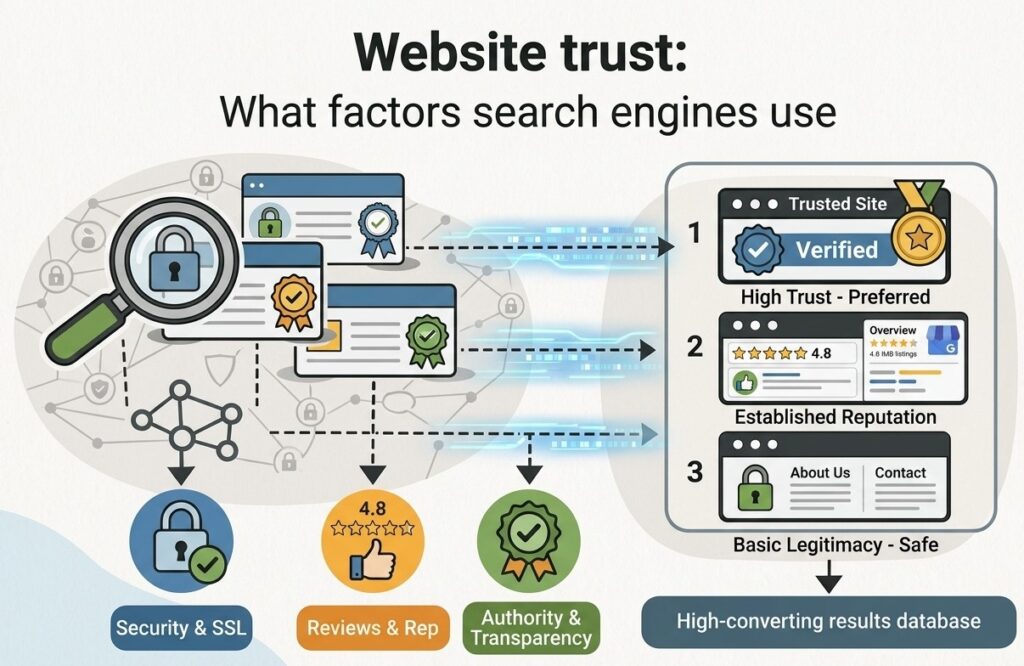
Search engines and homeowners are looking at the same page and drawing similar conclusions from it. A fast, mobile-friendly site with clear service pages and real content reads as a legitimate, established business. A slow, generic template with stock photography and vague service descriptions reads as unfinished, whether the visitor consciously notices it or not.
A few specific things carry outsized weight for a plumbing site:
•Licensing and insurance information, visible on the page rather than buried in an About section. A homeowner letting someone work on their plumbing wants to see this before they call.
•Real photos of your trucks, your team, and completed jobs. Stock photos of a generic wrench and pipe don’t tell anyone this is a real, local company.
•Clear service area and specialties. “We serve the metro area” says less than “we handle water heater repair and sewer line work in Plano, Frisco, and McKinney.”
None of these change your rankings dramatically on their own, but they change whether the person who finds you decides to call, which is the whole point of ranking in the first place.
Content that builds credibility along with keyword rankings
Search engines increasingly reward pages that demonstrate real expertise, and expertise is also exactly what earns a homeowner’s confidence. A blog post explaining why a water heater is making a popping noise, or what causes slab leaks in your specific region’s soil, does two things at once: it targets the searches homeowners run when something’s wrong, and it shows them your company knows what it’s talking about before a truck ever shows up.
This works best when it stays specific. A generic page about “the importance of regular plumbing maintenance” reads as filler. A page that names the actual signs of a failing water heater, gives a realistic repair timeline, and explains what a service call typically includes reads as a company that’s done this before. The specificity is what separates content that ranks and converts from content that just fills out a sitemap.
Reviews and reputation as the connective tissue
If visibility and trust meet anywhere, it’s in your review profile. Reviews influence rankings, they’re the first thing most homeowners check before calling, and they carry more weight than almost anything else on your website because they come from someone who isn’t you.
Building this into a routine matters more than any single tactic:
•Ask for a review right after the job is done, while the fix is still fresh in the customer’s mind.
•Respond to every review, including the negative ones. A calm, specific reply to a bad review often does more for trust than another five-star review would.
•Keep the flow steady rather than chasing a big batch once a year. A profile with new reviews every month looks like an active, busy business. One with a wall of reviews from three years ago looks stalled.
Common trust-killers that undermine SEO effort
A few mistakes cancel out otherwise solid local SEO work without anyone noticing why:
•An outdated site with old branding, broken links, or a copyright date from years ago. It signals neglect even if the plumbing work itself is excellent.
•Mismatched business information across platforms, which damages both rankings and a homeowner’s confidence that they’ve found the right company.
•No visible license number or insurance information, which is a hard stop for a segment of homeowners who specifically look for it before calling a plumber.
•Ignoring reviews, positive or negative, which makes an otherwise strong reputation look unmanaged.
Fixing these doesn’t take a redesign. It takes a page-by-page pass that asks whether each detail makes a stranger more comfortable letting your team into their home.
Bringing visibility and trust together
SEO for plumbing services isn’t really two separate jobs, ranking well and looking credible. It’s one job, because the signals search engines use to rank a plumbing business, real reviews, consistent information, a fast and informative website, licensing shown up front, are the same signals a homeowner uses to decide who gets the call.
Get the visibility work right and the trust work mostly follows, because you can’t fake either one to Google or to the person standing in two inches of water deciding who to call next.
See what your website is telling homeowners right now
Every plumbing company thinks their site looks trustworthy. Most haven’t checked. We’ll review your Google Business Profile, your reviews, and your website side by side with three competitors in your area, then show you exactly where you’re losing calls to a business that simply looks more credible online.
No cost. No obligation. Just a clear picture of where you stand.